Riichi vs other mahjong
"Mahjong" is a family of games, not one game. Japanese riichi, the Chinese and Hong Kong styles, and American mahjong grew from the same root, but they differ in tile count, scoring, equipment, and even what counts as a winning hand. This page maps the differences — facts, not a ranking — so you know what you're learning and what carries over.
Why riichi, and why now
If you've noticed more English-language mahjong content lately, it's almost all riichi. That traces to a few concrete shifts, not vibes:
- Free, quality online clients removed the biggest barrier. Mahjong Soul and Tenhou put a full, rules-accurate riichi table in a browser or phone — no physical set, no group of three other players, no cost. Riichi City followed with the same idea. The other branches don't have an equivalent online client at that scale.
- Streaming gave it an audience it never had. Mahjong Soul sessions and tournaments get streamed and clipped by VTubers and variety streamers, often with English commentary explaining calls in real time — the same discovery path that grew poker and chess audiences.
- A fixed rule set travels well. Riichi's legal hands don't change year to year, unlike American mahjong's annually revised card. That stability lets a ruleset (WRC 2025, EMA, or a house variant) be published once and referenced indefinitely — useful for an online client, a tournament circuit, or a course like this one.
- It reads like poker to poker players. Hidden information, a betting mechanic (the riichi stick), and pot-odds-style reads on opponents' discards give riichi a rules skeleton that's already familiar to a large existing audience — see riichi from a poker player's perspective.
- An in-person competitive scene now exists outside Japan. Bodies including the WRC, EMA, ARA, and UKMA run tournaments and grow local clubs, giving online players somewhere to play with real tiles once they've learned the rules.
None of this makes riichi "better" than the other branches — Chinese, Hong Kong, and American mahjong all have deep, healthy communities of their own. It explains why riichi specifically is the branch showing up in English-language streams, subreddits, and new clubs right now.
Where every branch agrees
All mahjong descends from games played in 19th-century China, and the shared core is easy to see: three numbered suits, wind and dragon tiles, and a loop of draw one tile, discard one tile until someone completes a hand. In most styles that hand is four sets plus a pair. Learn to read the tiles in one branch and you can read them in all of them. Everything past that core is where the branches split.
Riichi: the Japanese branch
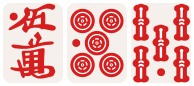
Riichi uses exactly 136 tiles — the three suits plus winds and dragons, with no flower tiles and no jokers. What defines the game is a cluster of rules the other branches don't have: you need at least one yaku 役 (scoring pattern) before you're allowed to win; a closed, ready hand can declare riichi with a 1,000-point bet; bonus tiles called dora ドラ add value without being yaku; and the furiten フリテン rule blocks you from winning off a discard if your own discards contain a tile of your wait. Scoring is a two-step calculation of han and fu.
Culturally, riichi is a closed-hand game. Calling opponents' discards is legal but usually costs you value, so players build quietly and lay their discards in ordered rows — which turns those rows into public information and makes defense half the game.
Chinese and Hong Kong styles
"Chinese mahjong" covers many regional variants; Hong Kong Old Style is a common casual baseline. It adds eight flower and season tiles for 144 in total. Flowers are set aside for bonus points the moment you draw them. Play is faster and more open than riichi: calling pung and chow is routine, there's no furiten and no riichi declaration, and scoring counts faan — with the payout roughly doubling per faan — which keeps the math quick. The Chinese Official ruleset used in international competition is a separate, pattern-heavy system with a minimum-point requirement, but the equipment is the same. Tiles are noticeably larger than Japanese ones, and there are no red fives.
American mahjong (NMJL)
American mahjong, standardized by the National Mah Jongg League, is structurally the furthest from the other two. It plays with 152 tiles: the base set plus eight flowers and eight jokers, which can stand in for tiles inside larger groupings. Winning hands don't follow the four-sets-and-a-pair frame at all — they must match one of the specific patterns printed on a card the league publishes each year, so the target hands change annually. Before play starts, players exchange tiles in a structured passing phase called the Charleston, and tiles are managed on racks. It's a rich game in its own right; it just shares less vocabulary with riichi than the Chinese styles do.
Side by side
| Riichi (Japanese) | Chinese / Hong Kong | American (NMJL) | |
|---|---|---|---|
| Tiles in play | 136 | 144 (adds 8 flowers/seasons) | 152 (adds 8 flowers, 8 jokers) |
| Jokers | None | None | Eight, with substitution rules |
| Winning hand | 4 sets + pair, must include a yaku | 4 sets + pair (minimums vary) | Must match a pattern on the yearly card |
| Scoring | Han and fu | Faan, doubling-based | Fixed values printed on the card |
| Signature rules | Riichi bet, dora, furiten | Flower bonuses, fast open calling | Charleston, joker exchanges |
The equipment is not interchangeable
Japanese tiles are small — roughly 26–30mm tall — while Chinese and Hong Kong sets typically run 38–42mm, and American sets fall in between, with racks to match. Automatic tables and tile accessories are built around one tile specification, so a table or set sized for one style often won't physically work with another. Measure and confirm compatibility rather than assuming "mahjong is mahjong".
Coming from Hong Kong or Chinese mahjong
Most of your game transfers: you already read the tiles, build sets, and call with confidence. Two rules will feel like ambushes. First, the yaku requirement — in riichi a complete hand with no yaku simply cannot be declared, so "ready" and "winnable" are no longer the same thing. Second, furiten: discard any tile of your own wait and you can't win off opponents at all. You'll also want to slow down on calling — pung and chow are legal here, but many of the valuable yaku require a closed hand, so the open, fast style that wins in Hong Kong often builds cheap hands in riichi.
Coming from American mahjong
The turn rhythm and wall etiquette carry over; almost everything else resets. There is no yearly card — the legal hand shapes in riichi are fixed and never change, which means the yaku list you learn once is yours for good. There are no jokers, so every tile in your hand is exactly what it shows, and there's no Charleston — the hand you're dealt is the hand you shape, one draw at a time. Sequences of consecutive tiles become a core building block rather than a card category, and one suit uses kanji numerals, which the tiles lesson covers in ten minutes.
Next: ready to learn the riichi side properly? Start from the How to Play course — lesson 1 begins with the tiles.