Fu, without the dread
Fu (符, “minipoints”) is the fine print of riichi scoring — and the single most-asked-about topic among English-speaking players. Here is the honest version: two shortcuts cover most hands, one addition rule covers the rest, and you can check yourself with our calculator while you learn.
The two shortcuts first
- Pinfu hands are always 30 fu on ron, 20 fu on tsumo. No counting.
- Chiitoitsu (seven pairs) is always 25 fu. No counting, no rounding.
Between pinfu-style hands and seven pairs, you have already covered a large share of the closed hands you will actually win. Everything else follows one recipe.
The recipe
- Start at 20 fu (the base everyone gets).
- Closed ron only: add 10 (the menzen bonus).
- Tsumo: add 2 (except pinfu).
- Add fu for each triplet or kan — see the table below.
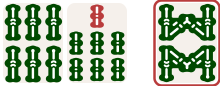
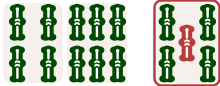
- Add fu for a hard wait: middle (kanchan), edge (penchan), or pair (tanki) wait = 2.
- Add 2 if the pair is a value tile (dragons, seat wind, round wind).
- Round up to the next 10.
Triplet and kan values
Triplets score more when concealed, and more again for terminals and honors. Kans quadruple the value:
| Open triplet | Concealed triplet | Open kan | Concealed kan | |
|---|---|---|---|---|
| Simples (2–8) | 2 | 4 | 8 | 16 |
| Terminals & honors | 4 | 8 | 16 | 32 |
Memory hook: open simple triplet = 2, and everything else doubles — concealed ×2, terminal/honor ×2, kan ×4. Sequences are always 0 fu.
Which waits add fu
Only awkward waits score. A two-sided wait adds nothing:
Worked example
Closed hand, won by ron on a middle wait, with a concealed triplet of honors:
- Base: 20
- Closed ron: +10
- Concealed honor triplet: +8
- Middle wait: +2
- Total: 40 → already a multiple of 10, stays 40 fu
With 2 han, 40 fu pays 2,600 (non-dealer ron). You can verify every step in the calculator.
A triplet completed by ron counts as an open triplet for fu — the discard came from outside your hand. Completed by tsumo, it is concealed. This one rule settles most fu arguments at real tables.
When fu doesn't matter
From 5 han up, forget all of this — the hand is at least a mangan and fu is ignored. At 3–4 han, high fu can push a hand over the 2,000-point base cap and turn it into a mangan early (3 han 70 fu and 4 han 40 fu are already mangan). That is why triplet-heavy hands surprise people: the han count looks modest, but the fu did the work.
Practice path
- Count only your own winning hands for a few sessions — announce the fu, then check with the calculator.
- Keep the score table open until the six everyday values stick.
- Then read the scoring overview again — it will feel obvious.