The shape of a hand
Nearly every winning hand in riichi is the same shape: four sets and a pair — fourteen tiles. Learn to see that pattern and every diagram on this site, and every real hand you ever hold, snaps into focus. This lesson is that pattern, piece by piece.
Four sets and a pair

Count it: four sets of three tiles, plus one pair — 4 × 3 + 2 = 14. A set is either a sequence or a triplet, and you can mix them in any combination: four sequences, four triplets, or anything in between. The shape alone doesn't win, though. A finished hand also needs at least one yaku, a recognized scoring pattern — that rule gets its own lesson. For now, the shape.
Sequences 順子 · shuntsu
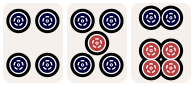
Three consecutive numbers, all in one suit. 4-5-6 of circles works; 4 of circles, 5 of characters, 6 of bamboo does not. Two more restrictions: numbers don't wrap around, so 9-1-2 is never a sequence, and honor tiles have no numbers, so winds and dragons can never form sequences. Sequences do most of the work in most hands — you'll see why in the section on waits.
Triplets 刻子 · koutsu
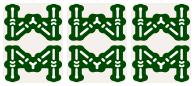
Three identical tiles. Any tile can form one, including honors — honors can only combine as identical copies (pairs, triplets, and kans), never as sequences. The four-of-a-kind, called a kan, counts as a single set and comes with its own procedure, covered in lesson 4.
The pair 雀頭 · jantou
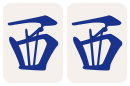
Exactly one pair, two identical tiles, and any tile in the game can be it. Japanese players call it the head of the hand. One pair — not zero, not two. A hand with two pairs and three sets is not finished; one of those pairs still has to become a triplet or break up.
Two special hands ignore the four-sets-and-a-pair pattern: chiitoitsu (seven distinct pairs) and kokushi musou (one of each terminal and honor, plus a second copy of any one of them). Everything else you will ever win — every hand in this course — is four sets and a pair.
Thirteen tiles, then draw and discard
If a finished hand is fourteen tiles, why do you hold thirteen? Because the game runs on a loop: draw one tile (fourteen), discard one tile (thirteen), repeat. Every player cycles through this, turn after turn, gradually trading useless tiles for useful ones. The only moment you genuinely keep a fourteenth tile is the moment you win. So think of your hand as thirteen tiles waiting for one more — which leads to the most important word in this lesson.
What is tenpai?

Tenpai テンパイ means your thirteen tiles are exactly one tile away from a complete hand. The hand above has three finished sequences and the pair; only 6-7 of bamboo is open, and either a 5s or an 8s completes it. Those completing tiles are your wait. Tenpai is the gateway to everything that matters: you must be tenpai to declare riichi, and at an exhausted deal, tenpai players collect points from noten (not-tenpai) players.
Before tenpai, players measure progress in shanten: the number of steps you are from tenpai. One useful tile away from tenpai is 1-shanten, two away is 2-shanten, and so on. You don't need to count shanten precisely yet — just know the ladder runs 2-shanten → 1-shanten → tenpai → win. The glossary has the full definition when you want it.
A first look at waits
Not all tenpai is equal — the shape of your last incomplete piece decides how many tiles can finish you. Five shapes cover almost everything:
| Wait | Shape | Completed by |
|---|---|---|
| Two-sided 両面 · ryanmen | 6-7 | 5 or 8 — up to eight tiles |
| Middle 嵌張 · kanchan | 4-6 | 5 only — up to four tiles |
| Edge 辺張 · penchan | 1-2 or 8-9 | 3 or 7 only — up to four tiles |
| Pair wait 単騎 · tanki | a lone tile | Its match — up to three tiles |
| Dual pair 双碰 · shanpon | two pairs | Either pair's tile (making it a triplet) — up to four tiles |
This is why sequences carry most hands: a two-sided shape can be finished by twice as many tiles as any other wait. Wait shapes come back twice later in the course — they change your score through fu, and they shape the riichi decision in lesson 5. For now, when you have a choice, keep the two-sided shape.
Prev: Lesson 1 — the tiles · Next: Lesson 3 — setup and the wall, where seats are drawn, the wall is built, and these thirteen tiles get dealt.